
Use cases

Many sources. Claims that need evidence. A cost of being wrong.

Every use case here has that shape. You ask in plain words and add documents. A team of AI models works in parallel, each claim links to its source, conflicts stay visible, and spending stops at your limit.

These describe intended use. Today the engine runs generated document-reconciliation cases on a simulator. None of these has been measured with real models or customer documents, so no results are shown.
A stack of paper files is sorted into three metal trays, with an orange tab marking one tray for review.

Flagship: reconcile what your documents really say

Hundreds of supplier contracts, amendments and emails. You need the agreed date, price or penalty for each supplier, and where documents disagree. This is what the engine does today on generated cases, and the first thing it will do on real ones.

See the worked example and try your own numbers
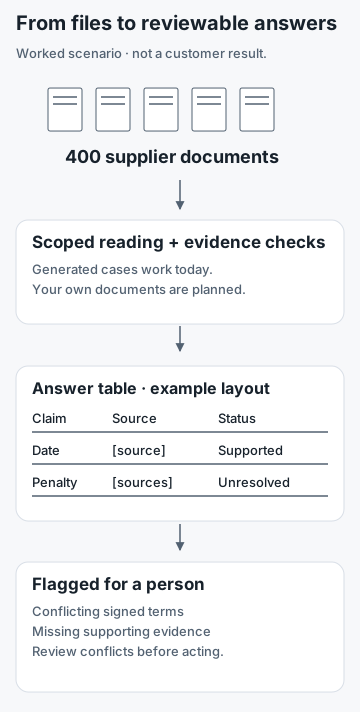
From files to reviewable answers. A hypothetical 400-document scenario yields a sourced answer table and a human review list. No invented supplier values are shown.

Six more with the same shape

Due-diligence data rooms

Who
Deal teams, investors and corporate lawyers
The pain
Thousands of files, a fixed deadline, and a missed clause that costs more than the whole review.
What they ask, in plain words
“List every change-of-control, exclusivity and termination clause in this data room, with the document and page, and show where contracts contradict the summary we were given.”
What they get
A clause table with a citation for each entry and a separate list of contradictions for a lawyer to settle.

What to measure

  • Share of known clauses found on a sample you have already reviewed
  • Claims whose citation does not support them
  • Reviewer hours on flagged items against a full read
  • Spend against the limit

Policy and regulation compliance checks

Who
Compliance, risk and quality leads
The pain
A new rule lands and nobody can say which internal policies and contracts it touches.
What they ask, in plain words
“Compare our policies with this regulation. For each requirement, say whether a policy covers it, quote the passage, and mark the requirements nothing covers.”
What they get
A requirement-by-requirement map with quoted passages, explicit gaps and the items where two policies disagree.

What to measure

  • Requirements correctly mapped on a hand-checked sample
  • Gaps missed and gaps wrongly reported
  • Unsupported quotes caught before commit
  • Time to a reviewable first draft

Tender and RFP responses

Who
Bid managers, sales engineers and founders
The pain
Hundreds of requirements, answers scattered across old bids and product documents, and a wrong claim that becomes a contract term.
What they ask, in plain words
“Answer each requirement in this tender from our approved documents only. Cite the source, and say clearly where we have no supported answer.”
What they get
A draft response where every answer cites an approved source, and an honest list of requirements with no supported answer.

What to measure

  • Answers accepted without edits by the bid owner
  • Answers with no valid source
  • Requirements left unanswered
  • Hours to a complete first draft

Incident and log investigations

Who
Site reliability, security and operations engineers
The pain
Too many logs, tickets and chat threads for one person or one context window, while the incident clock runs.
What they ask, in plain words
“Build a timeline of this incident from these logs, tickets and messages. Cite each event, and keep conflicting timestamps or accounts visible.”
What they get
A cited timeline, the open contradictions between sources, and the questions that the evidence cannot answer.

What to measure

  • Timeline events confirmed by the responders
  • Events with a wrong or missing citation
  • Contradictions surfaced that people had missed
  • Time to a usable timeline

Research synthesis

Who
Analysts, researchers and product strategists
The pain
A summary that sounds right, cites nothing and hides the papers that disagree.
What they ask, in plain words
“From these papers and reports, what is known about this question? Give each finding with its sources, and show where the sources disagree.”
What they get
Findings with sources attached, disagreements shown side by side, and claims marked unresolved where the evidence is thin.

What to measure

  • Findings whose sources support them on a spot check
  • Disagreements preserved against disagreements flattened
  • Sources never used
  • Cost against one strong model on the same question

Codebase and dependency audits

Who
Engineering leads and security reviewers
The pain
Hundreds of packages and services, licences and advisories spread across files, and no single person who knows it all.
What they ask, in plain words
“For each dependency in this repository, report its licence, known advisories in the files provided and where it is used. Flag conflicts between the lockfile and the manifests.”
What they get
An inventory with file references for every entry and a list of conflicts to fix. No tool is executed: the engine reads what you provide.

What to measure

  • Entries that match a manual audit of a sample
  • Findings with a wrong file reference
  • Conflicts found against conflicts known
  • Spend against the limit

Later, with physical AI models: site, plant and fleet inspection from video. Planned, not built.